
Understanding Doodles
There have been many misconceptions about what Doodles are and what they aren't. On this page we hope to dispel any misunderstandings and provide you with information which you need in making an informed choice for a lifelong companion.
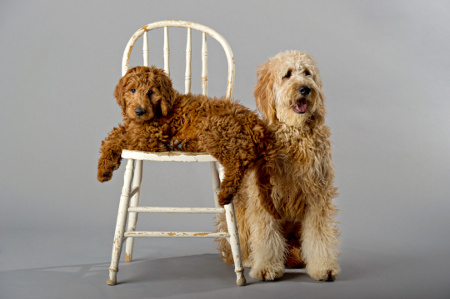
When we talk about Doodles we're referring to Goldendoodles, and Labradoodles together. There are other times we'll talk about them individually.
- Beginnings
- Awesome Crossbreeds, or Mutts?
- Shedding or Non-shedding, Don't be Misled
- Doodle Sizes
- The Colours of the Doodle
Beginnings
Labradoodles were first deliberately bred in Victoria, Australia in an attempt to produce a "hypoallergenic" guide dog. Wally Conren of the Australian Guide Dogs Association was approached in the early 1980's by a blind woman living in Hawaii whose husband was allergic to dogs. This first cross of a Labrador Retriever and a Standard Poodle resulted in a litter of 3 pups of which one was hypoallergenic to her husband. It was trained successfully as a guide dog.
In Hawaii, and elsewhere, Labradoodles became very popular amongst blind people. Since the 1980's the breed has escalated throughout Australia and the United States, and is now becoming more popular in Canada.
Goldendoodles probably came about in the mid 1990's. Although there is no definite time and place in history where we can say when the Goldendoodle was first bred (as we can with Labradoodles) we believe they were bred for the same reasons as the Labradoodle. As a cross between a Golden Retriever and a Poodle they have many excellent characteristics.
Many of the breeders of Goldendoodles and Labradoodles in Canada and the United States have high quality standards. At Hearty K9s we've developed the Quality Breeder's Checklist as our guideline to keep us at the top of our field as responsible, quality breeders. To the right you'll find a checklist of what we think you should look for in a Doodle breeder.
Awesome Crossbreeds, or Mutts?
Golden Retrievers are:- active, loving and outstanding family dogs
- known to enjoy pleasing their masters
- friendly with people and other dogs
- unlikely to attack people but make excellent watchdogs
- top performers in obedience competitions
- known to have congenital problems which include hip and eye disorders
- known to commonly have skin allergies
- rated 4th in intelligence
- known to be the ideal family dog
- reknown for their friendly nature and trainability
- late maturing dogs
- prone to obesity
- known to have congenital problems which include hip, elbow, shoulder, and eye disorders
- known to shed just about everywhere
- rated 7th in intelligence
- highly intelligent, rated second to the Border Collie
- committed to their owners
- early maturing
- small fussy eaters
- prone to congenital problems which include eye and knee disorders and hip disorders for Standard Poodles
- non-shedders
The biggest advantage to crossbreeding between unrelated breeds of the canine family is what is known as heterosis, or hybrid vigour, a term used to describe the increased fertility, growth, mental stability and good health which result when the progeny of two unrelated breeds are mated.
A cross between a Minature Poodle and a Retriever will tend to result in Doodle pups with only an eye problem in common with their parents. The larger Standard Poodle cross may additionally have hip problems. Our breeding dogs at Hearty K9s are eye and hip screened which decreases the incidence of these problems arising in our Doodle pups. We do selective first cross and backcross breeding to maintain a heterozygous gene pool, which results in healthier and happier pups. Backcross breeding is limited to unrelated progeny.
The Doodle crossbreed is a great combination between two desirable breeds. What you end up with is a versatile, easily trainable family dog. They do not mature too late, and do not as easily become overweight. They also possess the wonderful quality, from the Poodle's side, that lessens their doggy odour. A big advantage is the potential to have a low to non-shedding dog.
Shedding or Non-shedding, Don't be Misled
Not every Doodle will shed the same. A few will be non-shedders, and a few will be heavy shedders. Many are in the category of moderate to light shedders. Most Doodle breeders will admit that it is very difficult to determine how much a dog will shed until it is one year old.
It seems that the more their coat is like a poodle's curly fleece, the less likely it will shed, but even the wavy hair has been known to shed very little also.
- low maintenance brushing
- coats may vary in thickness
- hair is generally straight or has a minimal wave
- coat has a soft feel with loose curls
- not like hair, nor wool
- easy to care for as a puppy, but as an adult this coat is high maintenance
- tight curls like a poodle
- feels like a poodle coat
- high maintenance if kept at a longer length
Doodle Sizes
-
Standard
Height: 21 - 24?
Weight: Female 45 - 60 lbs, Male 55 - 77 lbs -
Medium
Height: 18 - 23?
Weight: 40 - 55 lbs (males on the heavier end) -
Miniature
Height: 17 - 20?
Weight: 26 - 55 lbs (males on the heavier end)
The Colours of the Doodle
- Black
- Cream
- Red
- Apricot
- Golden
- Bi-coloured
- About Us
- Understanding Doodles
- Our Puppy Program
- Today's Pups and News
- Tomorrow's Pups
- Yesterday's Pups
- Our K9s
- FAQ
- Sales Agreement
- Contact Us
Current Litters
River's & Clark's pups
Past Litters
2023
Eliza's & Derby's pups
Tula's & Clark's pups
Reena's & Marlo's pups
Basil's & Clark's pups
Mango's & Marlo's pups
Munchkin's & Marlo's pups
Groovy's & Simon's pups
Polly's & Abe's pups
Archives
Our Past Litters
Quality Checklist
- breeding dogs tested for hip dysplasia and genetic health
- first cross and backcross breeding of pups to retain a heterozygous gene pool
- breeding dogs are selected for their great personalities and sound temperaments
- early neurological stimulation
- New Skete stress training and socialization
- introduction to companionship and safe play with children and adults
- spacious exercise and play areas
- 2 year health and hip guarantee
- qualifies prospective owners for companionship match to Doodles